The reality is simple: more traffic does not automatically mean more conversions. Businesses that consistently improve landing pages, forms, calls-to-action, page speed, and user experience often achieve better results than competitors spending larger budgets on traffic acquisition alone.
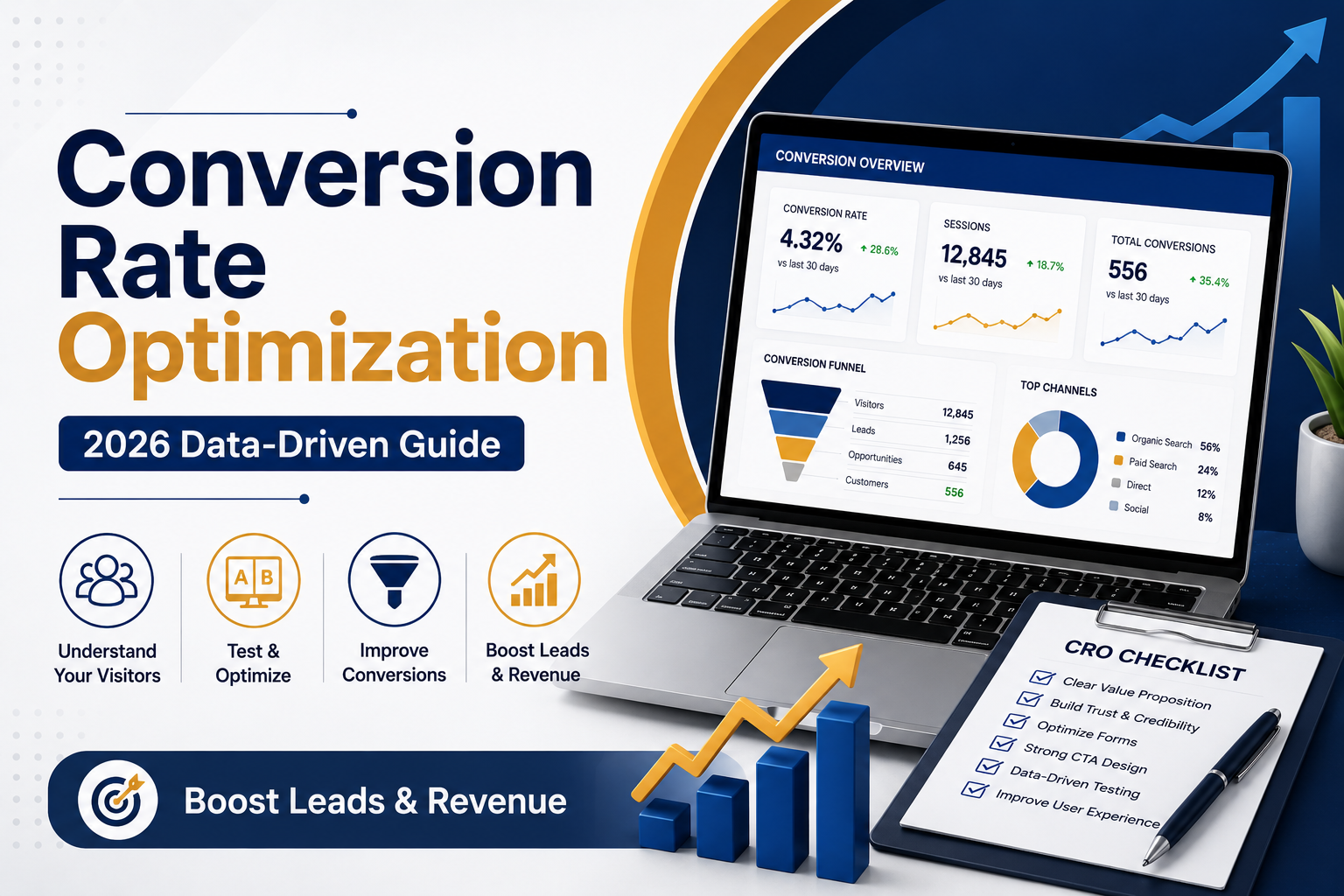
This Conversion Rate Optimization Checklist provides a practical framework for identifying conversion barriers, improving user journeys, and increasing the percentage of visitors who become leads or customers. Whether you’re a service-based company, ecommerce business, SaaS provider, or B2B organization, applying this checklist can help improve marketing ROI and overall business growth.
Why Every Business Needs a Conversion Rate Optimization Checklist
A structured Conversion Rate Optimization Checklist helps businesses focus on the areas that have the greatest impact on conversions. Instead of making random website changes, organizations can follow a proven process based on user behavior, testing, and performance data.
Companies across the United States are increasingly prioritizing conversion optimization because even small improvements can produce substantial revenue gains. Increasing a conversion rate from 2% to 3% may seem minor, but it represents a 50% increase in results from the same traffic volume.
By following a comprehensive Conversion Rate Optimization Checklist, businesses can uncover opportunities to improve user experience, reduce friction, and increase customer trust.
Headline and Value Proposition Optimization
One of the first items in any Conversion Rate Optimization Checklist is evaluating headlines and value propositions. Visitors should immediately understand what your business offers and why it matters.
Strong headlines align with visitor intent and clearly communicate benefits. Instead of generic statements, businesses should focus on outcomes, measurable results, and customer value. Supporting subheadings can reinforce credibility while addressing common objections.
Testing headline variations is often one of the fastest ways to improve conversion performance.
Strengthening Trust and Social Proof
Trust signals play a major role in every Conversion Rate Optimization Checklist. Modern consumers are more cautious than ever before and often require evidence before taking action.
Customer testimonials, case studies, online reviews, certifications, awards, and client logos all help establish credibility. Businesses that prominently display social proof typically experience stronger engagement and higher conversion rates.
Trust-building elements should appear throughout the website rather than being limited to a single section.
Form Optimization Strategies
Form performance is one of the most critical components of a Conversion Rate Optimization Checklist. Long or complicated forms frequently discourage users from completing inquiries or purchases.
Reducing unnecessary fields, simplifying layouts, and improving mobile usability can dramatically improve completion rates. Multi-step forms often outperform traditional long forms because they feel less overwhelming to users.
Businesses should continuously monitor form abandonment data and make improvements based on real user behavior.
Improving Call-to-Action Performance
Every Conversion Rate Optimization Checklist should include a detailed review of CTA design and messaging. Calls-to-action guide users toward the next step and directly impact conversion rates.
Effective CTAs use action-oriented language, clear value propositions, and visually distinct designs. Button placement, color contrast, surrounding whitespace, and supporting microcopy all influence performance.
A/B testing different CTA variations helps businesses identify which combinations generate the highest conversion rates.
Optimizing Website Copy and Messaging
Messaging plays a critical role in any Conversion Rate Optimization Checklist. Website copy should focus on customer benefits rather than company features.
Visitors want to understand how a product or service solves their problems. Clear, concise messaging that addresses pain points and provides solutions tends to outperform generic marketing language.
Specific numbers, measurable outcomes, and customer-focused language improve credibility and engagement throughout the conversion journey.
Enhancing Website Performance and User Experience
Website speed remains a key factor in every Conversion Rate Optimization Checklist. Slow-loading pages create frustration and increase bounce rates.
Businesses should regularly optimize images, reduce unnecessary scripts, leverage caching, and improve Core Web Vitals performance. Mobile responsiveness is equally important because a significant percentage of US website traffic now originates from smartphones and tablets.
Fast-loading websites create better user experiences and contribute to higher conversion rates.
A/B Testing and Continuous Improvement
A successful Conversion Rate Optimization Checklist is never completed once and forgotten. Conversion optimization requires ongoing testing and refinement.
A/B testing allows businesses to compare variations of headlines, CTAs, layouts, forms, and content to determine which version performs better. Consistent experimentation helps organizations make data-driven decisions rather than relying on assumptions.
Over time, small improvements accumulate and create substantial gains in conversion performance.
Ready to Improve Your Conversion Rates?
Implementing a proven Conversion Rate Optimization Checklist can help your business generate more leads, increase sales, and improve marketing ROI without increasing advertising budgets.
At Achivoo, we help businesses identify conversion barriers, optimize user experiences, and implement data-driven strategies that deliver measurable results.
Contact Achivoo
Website: https://www.achivoo.com/
Office: 180 Talmadge Rd, Edison, NJ 08817, United States
Email: contact@achivoo.com
Phone: +91 9152756565
Business Hours: Monday – Friday: 9:00 AM to 6:00 PM
Schedule a free conversion audit today and discover opportunities to improve website performance and revenue growth.
Conclusion
A comprehensive Conversion Rate Optimization Checklist helps businesses maximize the value of existing website traffic by improving user experience, reducing friction, and increasing trust. Rather than focusing solely on acquiring more visitors, companies can achieve substantial growth by converting a higher percentage of current traffic.
As competition continues to increase across the US market, businesses that consistently apply a structured Conversion Rate Optimization Checklist will be better positioned to improve leads, sales, and long-term profitability.
Frequently Asked Questions
What is a Conversion Rate Optimization Checklist?
A Conversion Rate Optimization Checklist is a structured framework used to identify and improve website elements that influence conversions, including headlines, forms, CTAs, trust signals, and page speed.
How often should businesses review a Conversion Rate Optimization Checklist?
Most businesses should review and update their conversion optimization efforts quarterly, while high-traffic websites may conduct testing and improvements monthly.
Does a Conversion Rate Optimization Checklist improve revenue?
Yes. By increasing the percentage of visitors who take desired actions, businesses can generate more leads and sales without increasing traffic acquisition costs.
What tools help with conversion optimization?
Popular tools include Google Analytics, Hotjar, Microsoft Clarity, Optimizely, VWO, and Google Tag Manager.
Why is A/B testing important?
A/B testing provides data-driven insights into what works best for your audience, helping improve conversions through continuous optimization.